
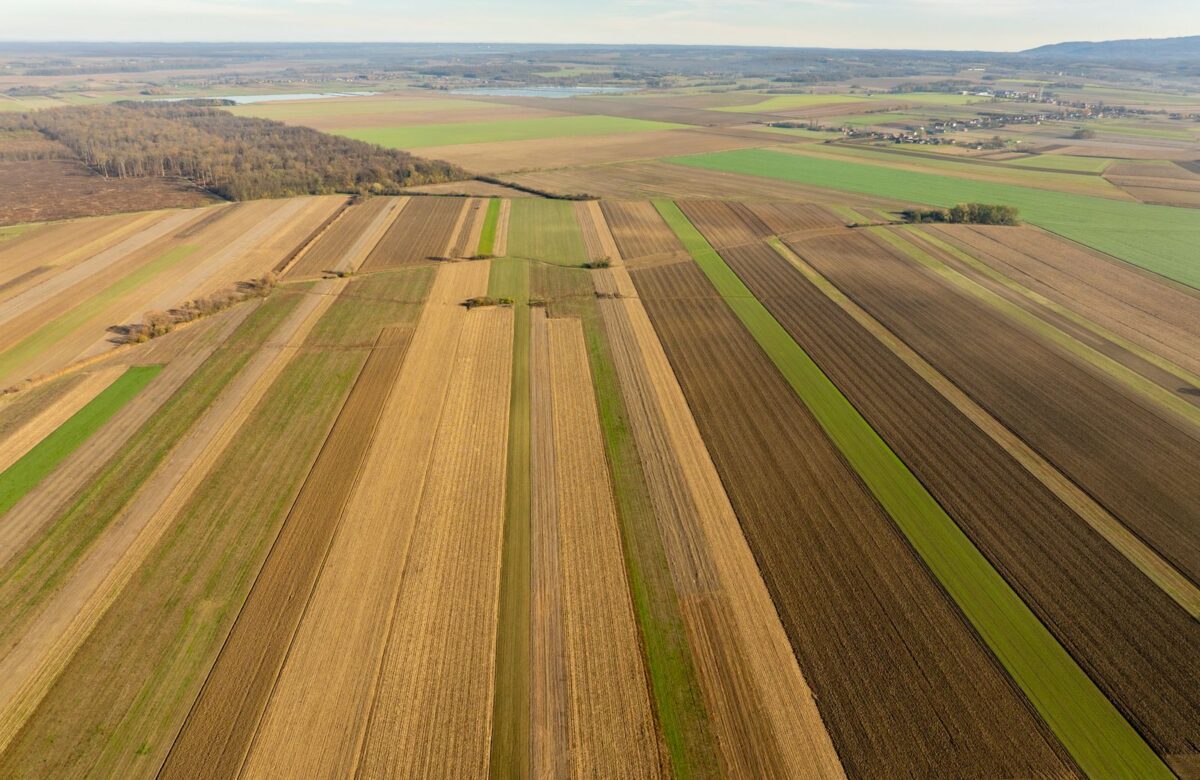
Guntha, Acre, Sq Ft: How Land Is Measured in Maharashtra
- 1 guntha = 1,089 square feet — the standard conversion used across Maharashtra.
- 40 guntha = 1 acre = 43,560 square feet; the arithmetic closes exactly, since 40 × 1,089 = 43,560.
- 1 acre = 4,046.86 square metres, and 1 square metre = 10.7639 square feet.
- 1 hectare = 2.471 acres = 10,000 square metres, roughly 98.84 guntha.
- The 7/12 extract records land in hectare–are–square metre (H–R–P), not guntha — so always reconcile a quoted guntha figure against the official record.
Buy land anywhere in the Karjat–Khopoli–Alibaug belt and you will hear three units in the same conversation: guntha from the seller, square feet from the broker, and hectare–are from the 7/12 extract. Here is one table that ties them all together, plus a worked price example.
How many square feet is one guntha?
One guntha equals 1,089 square feet. It is the standard land-measurement unit used across rural Maharashtra, and the 1,089 figure is fixed, not a regional approximation.
The number comes from the guntha’s historical definition as a square of roughly 33 feet by 33 feet, which gives 1,089 square feet. To convert any guntha figure to square feet, multiply by 1,089: a 5-guntha plot is 5 × 1,089 = 5,445 square feet. Brokers and listing portals usually quote plot sizes in square feet, while the seller and the village records think in guntha and acre, so this is the first conversion most buyers need.
How many guntha make an acre?
Forty guntha make one acre, and one acre is 43,560 square feet. The two conversions are consistent with each other: 40 guntha × 1,089 square feet = 43,560 square feet, with no rounding.
So one guntha is one-fortieth of an acre, or 0.025 acre. If a seller quotes a plot as “20 guntha”, that is half an acre (20 ÷ 40), or 21,780 square feet. Working the other way, a 2.5-acre parcel is 100 guntha. Because the acre and the guntha lock together cleanly, you can move between the seller’s unit and the broker’s square-foot number without accumulating error.
How do guntha, acre, hectare and square metre relate?
The cleanest way to hold all four units together is a single conversion table built on two anchors: 1 guntha = 1,089 square feet and 1 square metre = 10.7639 square feet. Everything else follows from those.
| Unit | Square feet | Square metres | In acres |
|---|---|---|---|
| 1 guntha | 1,089 | 101.17 | 0.025 (1/40) |
| 1 are | 1,076.39 | 100 | 0.0247 |
| 1 acre (40 guntha) | 43,560 | 4,046.86 | 1 |
| 1 hectare | 1,07,639 | 10,000 | 2.471 |
| 1 square metre | 10.7639 | 1 | 0.000247 |
A few relationships are worth memorising from the table: a hectare is about 98.84 guntha (1,07,639 ÷ 1,089), a guntha and an are are close but not equal (a guntha is about 1.0117 are), and a hectare is 2.471 acres. These let you sanity-check any figure a seller or portal gives you in seconds.
How do you convert guntha to square metres?
One guntha is 101.17 square metres, found by dividing 1,089 square feet by 10.7639. The square metre matters because the 7/12 extract and official area records in Maharashtra are kept in square metres, not square feet.
The chain is simple: 1 guntha = 1,089 sq ft, and dividing by 10.7639 sq ft per sq m gives 101.17 sq m. An are, the unit behind the “R” in the 7/12’s hectare–are–square-metre format, is exactly 100 square metres — so a guntha is marginally larger than an are. This small difference is why a plot’s guntha figure and its 7/12 area in are will not match exactly, and knowing that avoids a false alarm when the two numbers differ slightly.
What does a worked guntha-to-rupees example look like?
Say a seller quotes a 10-guntha plot at a sample rate of ₹3,000 per square foot. First convert to square feet: 10 × 1,089 = 10,890 square feet. Then multiply by the rate: 10,890 × ₹3,000 = ₹3,26,70,000.
| Step | Calculation | Result |
|---|---|---|
| Plot size | 10 guntha | 0.25 acre |
| Convert to square feet | 10 × 1,089 | 10,890 sq ft |
| Apply sample rate | 10,890 × ₹3,000 | ₹3,26,70,000 |
The ₹3,000 per square foot here is only an illustrative rate to show the method — it is not a Karjat or Khopoli price quote. The point is the sequence: convert the area to the unit your rate is quoted in, then multiply. If the rate had been quoted per guntha or per acre instead, you would convert the plot to that unit first. Mixing units — a per-square-foot rate against a guntha area — is the most common way buyers mis-estimate a plot’s price.
Why does the 7/12 extract use hectare and are, not guntha?
Maharashtra’s land records follow the metric system, so the 7/12 extract records area in hectare, are and square metre — the H–R–P format — rather than in the traditional guntha and acre that change hands in conversation.
That means the official document and the spoken deal use different units, and the buyer is the one who has to reconcile them. A plot described as “1 acre” by the seller should read as about 0.4047 hectare on the 7/12; “20 guntha” should read as roughly 0.2023 hectare, or 20 are and a little more. If the record and the quote diverge by more than this rounding, treat it as a discrepancy to resolve before proceeding, not a conversion quirk to wave away.
What should you check before trusting a quoted area?
Confirm which guntha value is being used, convert everything into one unit before comparing price or area, and match the final figure against the 7/12 extract and the property card — because the number that governs your purchase is the one in the official record, not the one in the listing.
In practice: ask the seller for the area in both guntha and the 7/12’s hectare–are figure, run the conversion yourself using the table above, and flag any gap. A clean plot’s spoken size, its square-foot listing and its recorded H–R–P area should all tie out within rounding. Where they do not, the measurement question is really a title or boundary question in disguise, and it is worth settling before money moves.
FAQ
How many square feet is 1 guntha?
One guntha is 1,089 square feet. This is the standard conversion across Maharashtra, derived from a square of about 33 feet by 33 feet. To convert guntha to square feet, multiply the number of guntha by 1,089.
How many guntha are in 1 acre?
Forty guntha make one acre. Since one guntha is 1,089 square feet, 40 guntha equal 43,560 square feet, which is exactly one acre. One guntha is therefore 0.025 acre, or one-fortieth of an acre.
How many square metres is 1 guntha?
One guntha is 101.17 square metres, calculated by dividing 1,089 square feet by 10.7639 square feet per square metre. This matters because Maharashtra’s 7/12 extract records area in square metres, not square feet.
How many acres is 1 hectare?
One hectare is 2.471 acres, or 10,000 square metres, or about 1,07,639 square feet. In guntha terms a hectare is roughly 98.84 guntha. A hectare is the largest of the common land units used in Maharashtra records.
Why doesn’t the guntha figure match the 7/12 extract area?
Because the 7/12 records area in hectare, are and square metre, while sellers quote in guntha and acre. A guntha (101.17 sq m) is slightly larger than an are (100 sq m), so the numbers will differ a little by design. Large gaps, though, signal a discrepancy to resolve.
How do I calculate a plot’s price from its guntha size?
Convert the guntha area into the unit your rate is quoted in, then multiply. For a per-square-foot rate, multiply guntha by 1,089 to get square feet, then by the rate. For example, 10 guntha is 10,890 square feet, which at a sample rate of ₹3,000 per square foot works out to ₹3,26,70,000.
Sizing up a plot in the corridor?
Converting units is the easy part — matching a quoted area to the 7/12 and the boundaries on the ground is where deals are won or lost. If you are evaluating a specific plot in the Karjat–Khopoli–Alibaug belt, our team can help you verify the numbers.
Related reading
- 7/12 extract in 2026: how to read it before buying
- Raigad plot stamp duty in 2026
- What sets Karjat land prices in 2026
- Is a plot NA in Maharashtra 2026? How to check
Costing a plot
- The full cost of buying a plot — charges beyond the headline price.
- The plot cost calculator — add up the true outlay.
- Karjat-Khopoli ready reckoner 2026 — the stamp-duty valuation floor.
- Land under 25 lakh near Mumbai — the entry-level budget.
- 20 to 50 lakh plots in Karjat-Khopoli — the mid-budget band.
- 1 crore land near Mumbai — what a crore buys today.
Records and NA
- What a property card (8A) shows — the city-survey record.
- The “other rights” column on a 7/12 — where loans and disputes surface.
- What NA (non-agricultural) land means — the status that makes a plot buildable.
- NA plot vs agricultural land — the difference that decides use.
- The land-title checklist — documents to demand before you pay.
- Registering a land sale in Maharashtra — the step that secures possession.
- The order to check land documents — what to verify first.
Corridor and strategy
- Land on the Khopoli-Pali road (SH-93) in 2026 — the corridor hub guide.
- Khopoli-Pali land prices in 2026 — asking bands village by village.
- Karjat vs Khopoli — comparing two corridors.
- How to shortlist a plot — a disciplined way to compare.
- How to compare land corridors — a framework for choosing.
- Land banking near Mumbai — holding land for the long term.
Citations and sources
Conversion constants are standard metric and customary land-unit definitions: 1 guntha = 1,089 sq ft, 40 guntha = 1 acre = 43,560 sq ft, 1 acre = 4,046.86 sq m, 1 sq m = 10.7639 sq ft, 1 hectare = 10,000 sq m = 2.471 acres. Maharashtra land records (7/12 extract) are maintained in hectare–are–square metre by the Maharashtra Department of Land Records (Mahabhulekh); ready-reckoner area units via IGR Maharashtra. Guntha and acre values cross-checked against Bajaj and Tata Capital conversion references. The ₹3,000 per square foot used in the example is illustrative only and not a market quote.
